
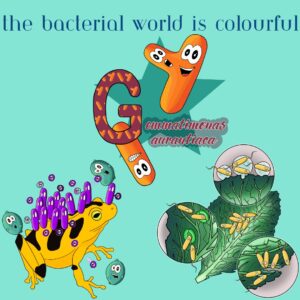
Serratia in the BacterialWorld

The genus Serratia includes ubiquitous Gram-negative bacteria in water and soil. Serratia marcescens, the best-described species, is widely distributed in nature, including in soil, water bodies, plants and animals and in the human urinary and respiratory tracts. Some Serratia species have also been identified as opportunistic pathogens of humans and insects.

You can easily recognise some Serratia species. They produce prodigiosin, a red pigment that can give colonies or contaminated surfaces a blood-like appearance. That’s why Serratia rubidaea, Serratia nematodiphila and Serratia plymuthica can appear as red, blood-like dots on contaminated food.

Prodigiosin is a secondary metabolite: a compound that is not essential for survival under all conditions, but can increase bacterial fitness under stress. For Serratia, the red pigment links to defence and competition. Prodigiosin can inhibit the growth of several bacterial, fungal and insecticidal pathogens. For example, Serratia marcescens contributes to the biocontrol of plant diseases by inhibiting the growth of several phytopathogens. On amphibian skin, the red antibiotic produced can protect against deadly fungi.

Serratia marcescens also carries other microbial weapons, such as the antibacterial and antifungal Type VI secretion system. Using it, it shoots toxic effectors into competing bacteria to get rid of them and become the sole survivor in the niche.

Learn about more bacteria

Creating the colours of the rainbow: Bacteria and the vibrant world of pigments

Our world as well as the bacterial world are full of vibrant colours. These colours exist thanks to biopigments; molecules able to capture light and reflect the corresponding colour. Many organisms, as well as bacteria, learned to use biopigments to harvest energy from sunlight, fight foes and adapt to new and challenging environments. Read on to learn what makes the bacterial world so colourful and why biopigments are the Earth’s life savers.
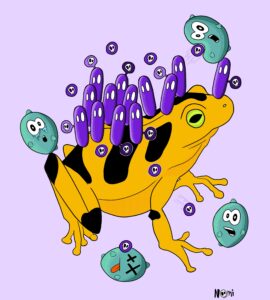
Bacteria produce colourful antibiotics to protect frogs

A deadly fungus kills many exotic amphibians. Luckily, some bacteria antibiotics to kill the fungal intruder and thus protect the animal. With this colourful strategy, the right microbial community might even save whole species from extinction.