Myxococcus in the BacterialWorld

Myxococcus shows that bacterial life can be far more organised than a single cell living on its own. These bacteria are part of the myxobacteria, a group known for multicellular behaviour, coordinated movement and group predation.

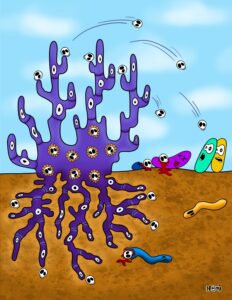
Some myxobacteria can form large multicellular aggregates called fruiting bodies. These structures may contain up to about 100,000 cells and exist to protect their spores. The fruiting body helps feed and transport them, while the spores are kept at the core.

This makes Myxococcus a powerful example of multicellular bacteria. They organise into biological aggregates with superpowers that are more complex than those of individual cells. This organisation can involve communication between cells, division of labour and cell differentiation. When some cells take on specialised functions, the whole bacterial group gains abilities that an individual cell would not have alone.

But Myxococcus are also described as wolf-pack predators. Rather than attacking prey as isolated cells, they travel as huge aggregates to attack their prey. They rely on twitching or gliding motility, forms of movement that help the group move across surfaces. As colonies of Myxococcus roll over their prey, they release antibiotics, kill it and then feed on it.

So Myxococcus is best understood as a social bacterial genus. Its cells can organise into multicellular structures, protect spores, move as a group and attack prey together. It reminds us that bacteria are not always solitary microbes. Some organise, move and survive as a coordinated collective.

Learn about more bacteria

Bacteria use antibiotics to kill their foes and protect others

We use antibiotics to kill bacteria and fungi. Yet, antibiotics are produced by these microbes to ensure their own survival in the environment. But not only microbes that produce antibiotics benefit from them, but often even other organisms. Read on to find out how antibiotics can help many players.
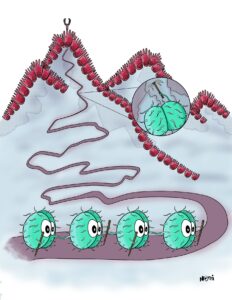
Neisseria gonorrhoeae uses their bacterial pili to attach to human gut cells.

About twitching bacteria and their pili

Some bacteria have special hair-like structures to connect to surfaces or other organisms. These bacterial pili help them move along that surface or pull themselves closer to a prey or host. Read about why bacteria need those pili when they are out hunting or infecting us.

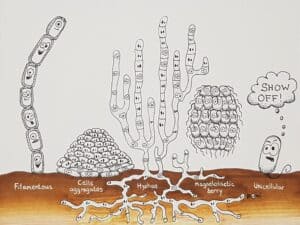
Bacteria can form multicellular organisms. They can form bacterial filaments, multicellular aggregates, hyphae networks or magnetotactic multicellular prokaryotes.

Together we are strong – bacteria form multicellular organisms

When thinking of bacteria, you might have the picture of a single cell in your mind. But interestingly, some bacteria come as multicellular organisms with advanced functions. Here, we will learn what multicellular bacteria are and why bacteria form multicellular organisms. We will then look at some colourful examples of multicellular bacteria.