Pregnancy transforms the body in remarkable ways.
Some changes are obvious and you have heard of, like morning sickness and sudden cravings.
Others are far less visible, including the microbial communities that live in and on the mother-to-be.
What exactly happens to the microbiome during pregnancy? And why does it matter for a healthy pregnancy and birth?
Let’s take a closer look.
How the immune system keeps track of what to attack and what to tolerate
One of the main roles of the immune system is to fight off anything foreign. At first, a mother’s immune system also sees the baby growing inside her as foreign, even an enemy.
But rather than fighting or even eliminating it, the body has preventative mechanisms built in: so-called immune tolerance. This mechanism locks immune cells into a non-responsive mode.
Imagine immune cells as immigration officers at an airport: they check a person’s details to see if they match the passport. Similarly, immune cells check every cell inside the body for proteins on the outside. Some of these proteins activate the immune cell’s danger system, meaning the cells then eliminate the foreigner.
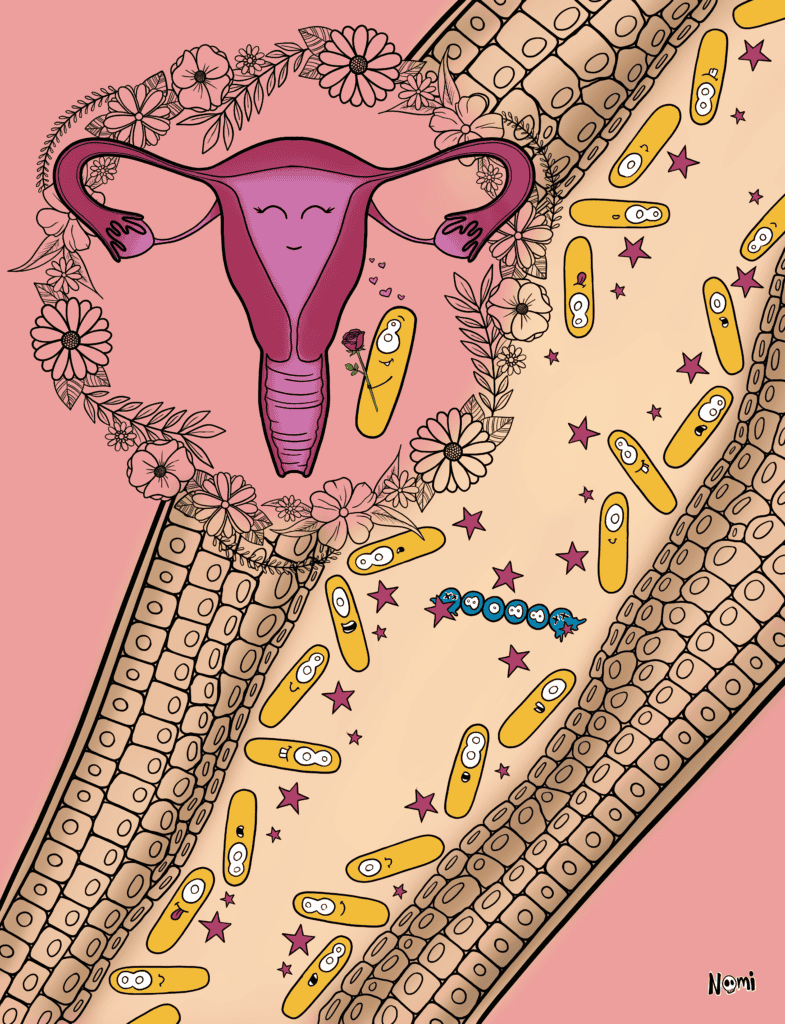
Yet the immune system needs to be mindful. Immune cells need to correctly distinguish disease-causing bacteria from commensal bacteria, such as Lactobacilli that generally live in the vaginal tract.
Similarly, immune cells recognise and tolerate the growing foetus. Proteins on its surface prevent immune cells from activating. I like to think of them as ‘don’t eat me’ signals. In scientific lingo, they’re called non-classical MHC class I isotypes HLA-E and HLA-G.
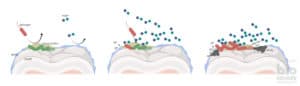
On the other hand, pathogenic fungi like Candida albicans are examples of how both the immune system and beneficial bacteria work together to keep us healthy. The commensal bacterium Lactobacillus competes with Candida and normally keeps it from overgrowing.
But when there are not enough Lactobacilli to protect us, our second layer of protection, the immune system, steps in. When Candida infects us, it damages some of the body’s inner walls, which activates other players in the immune system. Eventually, immune cells, like natural killer cells and neutrophils, come in and kill the fungi.
Finally, the placenta plays another important role. The placental barrier limits mixing of maternal and foetal blood, and thus immune cells. In this way, maternal immune cells will not come into contact with the foetus, so they won’t get activated.
Roles of the microbiome during pregnancy
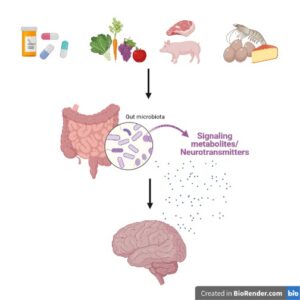
The immune system does not do this job alone: throughout pregnancy, microbial communities, particularly in the vagina and gut, support the health of both the mother and the baby.
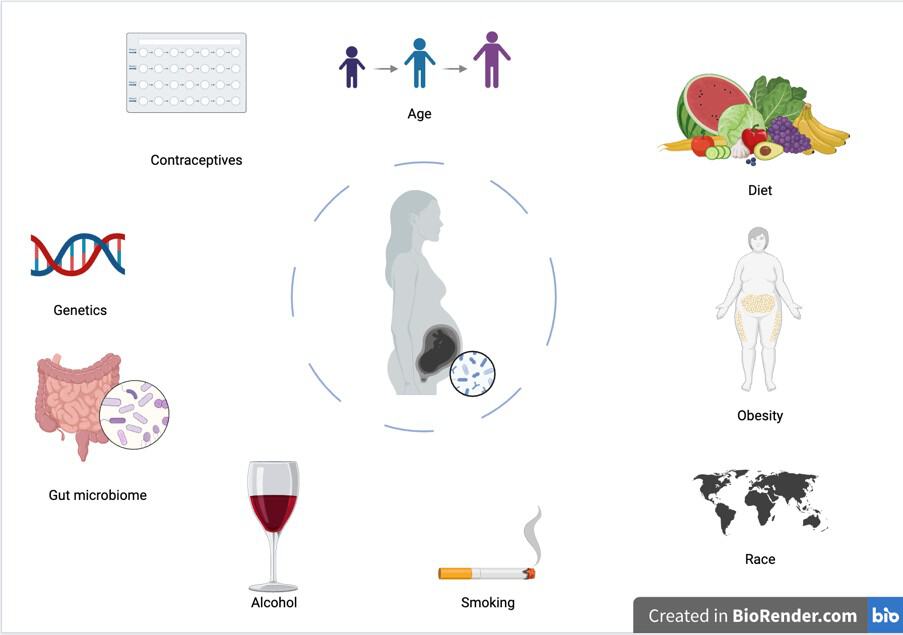
The vaginal microbiome changes according to age, race, sexual intercourse, smoking, contraception, lifestyle and diet. Swabs taken from pregnant women showed that while Lactobacillus was dominant, the vaginal microbiome as a whole was stable.
The main role of Lactobacillus is to create an acidic environment (pH < 4.5) by breaking down glycogen. Vaginal epithelial cells store glycogen, from which Lactobacillus produces smaller sugars and, ultimately, lactic acid. This makes the vaginal flora more acidic and prevents dangerous microbes from growing. At the same time, lactic acid is a signal for the immune cells to stand down, or to switch into a tolerogenic mode.
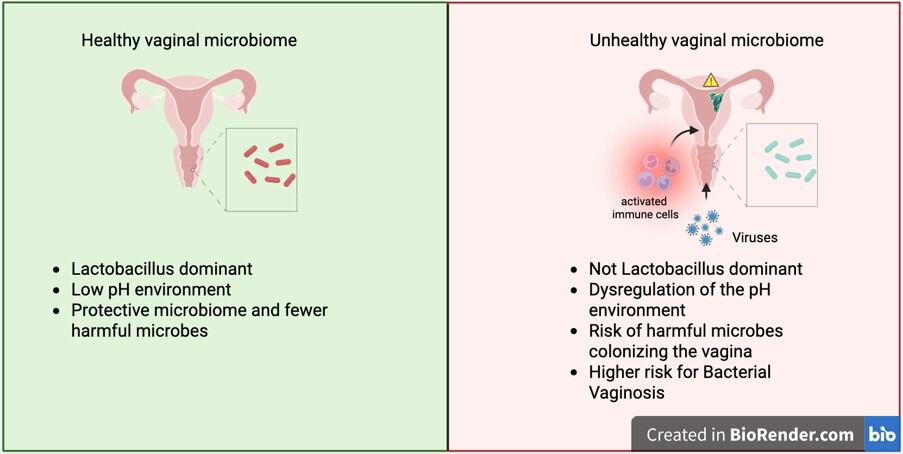
In pregnant women, hormonal and genetic differences also shape which Lactobacillus subspecies mainly reside in and on them. In particular, hormones like oestrogen influence how much glycogen is deposited in the vaginal walls. This affects the amount of Lactobacillus species and, as a result, the entire vaginal microbiome.
Moreover, pre-term births were also associated with higher levels of inflammatory signals. These activate immune cells, which change the microbiome. Instead of Lactobacillus, Prevotella and Sneathia amnii become dominant.
Infertile women also had a low prevalence of Lactobacillus. However, this raises a chicken-and-egg scenario: whether inflammation initially causes microbiome disruption, or whether vaginal microbiome dysbiosis initiates inflammation, this mystery remains unresolved (for now).
Either way, some researchers suggested using the microbiome as a predictor of successful pregnancy. This may become an important tool for in vitro fertilisations.
The vaginal microbiome changes throughout pregnancy
During pregnancy, the vaginal microbiome helps protect against foreign pathogens by maintaining a Lactobacillus dominance and thus an acidic environment.
The microbiome adapts to various factors, such as diet, hormones, obesity, genetics and age etc. These factors can change the microbiome for better or worse. However, we do not have a complete picture of how these factors work together.
Diet plays an important role in maintaining a healthy microbiome. To understand whether there is a link between the vaginal microbiome and diet, researchers compared vegetarian and non-vegetarian diets.
Indeed, women following a vegetarian diet had a more complex vaginal microbiome. Although it remains unclear how or which nutrients are responsible for this diversity.
One initial suggestion to increase estrogen levels and help Lactobacillus survive was to be on a high-fat diet. However, when this hypothesis was tested, they found that high-fat intake was associated with severe bacterial vaginosis.
Unfortunately, maternal obesity is another risk factor that has been on the rise recently, and now there have been associations with obesity and pregnancy complications. Obesity alters the microbiome and promotes the growth of harmful gut bacteria.
These move toward the placenta and disrupt the placenta’s stable immune environment. Moreover, children of mothers who were obese during pregnancy have an increased risk of obesity and type 2 diabetes later in life.
However, diet goes both ways. While having a high-fat diet is associated with complications, it can also be improved. Diets rich in fibre, plant-based proteins and omega-3 fatty acids are beneficial for both the mother and the baby.
Can microbes support a mother’s and a baby’s health?
Based on these preliminary results, researchers are exploring ways to support a healthier microbiome during pregnancy. Some experimental approaches, such as vaginal microbiome transplantation, aim to transfer beneficial bacteria from healthy donors to people with vaginal dysbiosis.
More traditional approaches, including oral or vaginal Lactobacillus probiotics, are also being studied to see whether they can help during pregnancy. However, these strategies are still under investigation and are not approved so far.
As you could see here, pregnancy is not just an adventurous story of hormones and cravings. Also a mother’s microbiome goes on a little adventure.
A mother’s immune system needs to learn to tolerate the growing foetus while still policing potential threats. Microbes in the vagina and gut support this mission by keeping acidic conditions stable and signalling to immune cells.
While we do not yet fully understand the links between commensal microbes and pregnancy outcomes, we do know that certain factors can shift microbial communities. Let’s see what research reveals next on how to support a mother-to-be and her baby.